Testing a Hosting Quote Against Pool Arithmetic
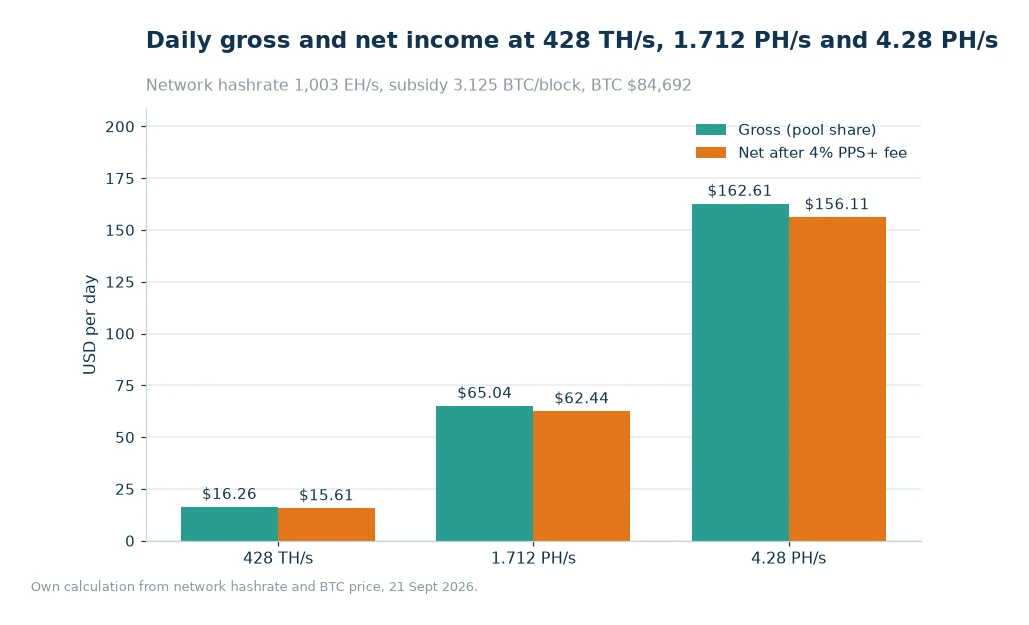
A hosting quote tells you what a slot costs. The pool tells you what the machine in it earns. Keeping those two sentences apart is the whole skill, and at 428 TH/s the numbers are small enough to check by hand: 0.000192 BTC a day, $16.26 gross, $15.61 after the listed 4% on the block-reward component. A quote that swallows more than that is not a hosting deal, it is a subsidy.
Key takeaways
- At 428 TH/s the pool credit is $16.26 a day gross and $15.61 net of the listed 4% on the block-reward component.
- Any hosting quote above roughly $15 a day for one such machine leaves nothing before hardware depreciation.
- Ask for the all-in rate per kilowatt-hour and the promised uptime, in writing, before comparing two hosts.
- Run the same arithmetic at 1.712 PH/s and 4.28 PH/s so a quote can be scaled rather than renegotiated.
The quote is a cost, the pool is an output
Sales conversations blur the two because blurring helps the sale. A monthly figure of $210 for a slot sounds reasonable until it sits beside a daily credit of $15.61, where it consumes about 45% of revenue before any hardware cost. The same $210 against a 1.712 PH/s parcel consuming four slots looks different again, which is why the comparison has to be per machine rather than per invoice.
I keep two columns on one page and never let them share a total until the end. Left column: pool credit, fee, net. Right column: hosting, power pass-through, setup fee, minimum term. The verdict is the difference, and it is only meaningful after both columns are complete.
Two numbers to ask the sales rep for
The first is the all-in cost per kilowatt-hour, including cooling and any facility charge. The second is the promised uptime, expressed as hours per month rather than a percentage, because percentages are easy to round in a brochure. A quote that answers only the first question cannot be compared with one that answers both.
Ask a third question as well, even though it is not a number: what happens to the fee when the machine is offline through no fault of yours. The answer separates a host that bills for capacity from one that bills for service, and the two are not interchangeable when a transformer fails on a Friday. Get that sentence into the email thread before the contract draft arrives, because a clause added after the draft is a favour and a clause added before it is a term.
Quote versus credit at 428 TH/s
The table uses a hypothetical $7 a day hosting charge, which is roughly $210 a month, to show the shape of the comparison rather than to endorse a price.
| Line | Per day | Per 30 days |
|---|---|---|
| Pool credit, gross | $16.26 | $487.80 |
| Credit net of the listed 4% | $15.61 | $468.30 |
| Illustrative hosting charge | $7.00 | $210.00 |
| Remainder before hardware cost | $8.61 | $258.30 |
Five rows and the negotiation is over. A host asking $12 a day leaves $3.61; a host asking $16 leaves nothing. Notice that the listed pool fee, at 65 cents a day, is smaller than the gap between two plausible hosting quotes. That ordering is the point of the exercise.
Uptime assumptions you should write down
A credit of $15.61 a day assumes the machine runs all day. At 98% uptime the same machine credits about $15.30, and at 95% about $14.83. Those differences look trivial in a single day and add up to real money across a year, which is why the uptime clause deserves more attention than the headline hosting rate.
Write the assumption into the comparison sheet and mark it as assumed. When the first month closes, replace it with the measured figure. A quote evaluated against an assumed 99% uptime and delivered at 96% was not a bad quote; it was a bad assumption, and the sheet should show which one failed.
Where the arithmetic disagrees with the brochure
Brochures tend to quote revenue per machine at a favourable price and a favourable difficulty. The disagreement usually comes from one of three places: a price older than the quote, a difficulty figure from before the last adjustment, or a hashrate measured at the wall rather than at the pool. None of these is dishonest. All of them flatter the machine.
Rebuild the revenue line yourself with the ViaBTC Mining Calculator, then hold it against the quote. If your figure is lower than the brochure's, the brochure is out of date and the quote should be judged against yours. If yours is higher, check the hashrate field before celebrating. The Profit Calculator is only as honest as the numbers typed into it, and the fee field is the one place where a default can quietly differ from the current published rate.
A short list before signing
Four items: the all-in rate per kilowatt-hour, the uptime commitment with a remedy clause, the repair policy including who pays for parts, and the notice period for leaving. A host that supplies all four in writing is comparable with another host that does the same. One that supplies two is asking for trust instead of a contract.
The Mining Farms listing is a reasonable place to collect candidates, and the fee schedule supplies the one number in the whole comparison that does not have to be negotiated. Everything else is a conversation, and conversations should end with a document.
Worked example
Here is how the 428 TH/s credit is built, step by step, so the quote has something solid to sit against.
- Gigahash: 428 TH/s = 428,000 GH/s.
- Network share: 428,000 ÷ 1,003,107,267,295 = 0.00000042667.
- Daily coins: 0.00000042667 × 450 = 0.00019200 BTC.
- Gross at $84,692: 0.00019200 × 84,692 = $16.26.
- Listed 4% line: 16.26 × 0.04 = $0.65.
- Net: 16.26 − 0.65 = $15.61 a day, or $468.30 over 30 days.
- Against a $7.00 daily hosting charge: 15.61 − 7.00 = $8.61 a day, or $258.30 a month before hardware depreciation.
Scale it before signing anything at a larger size. Four machines at 1.712 PH/s credit $62.44 net a day, and ten at 4.28 PH/s credit $156.11. If the host's price is flat per machine, the arithmetic scales cleanly; if it steps down at volume, ask which tier the quote assumes and get that tier written into the contract.
Frequently asked questions
What is a reasonable hosting charge for one machine?
There is no single figure, because power markets differ, but the test is arithmetic: at 428 TH/s the pool credits $15.61 a day after the listed rate, so a charge close to that leaves nothing for hardware and should be treated as a warning.
Should the hosting fee be paid in coins or cash?
Whichever keeps the ledger simple for you, but convert both to the same unit before comparing quotes; a fee quoted in BTC moves with the price while a fee quoted in dollars does not.
How do I check a host's claimed uptime?
Compare the pool credit for the first full month against the figure for continuous running; a gap larger than the promised downtime is the first thing to raise with the host, with the settlement export attached.
Compare the two columns one last time
Before the signature, read the sheet from the top: gross credit, listed fee, net credit, hosting, remainder. If the remainder is thinner than the hardware depreciation you expect over the contract term, the deal does not work at this hashrate no matter how good the facility looks. If it is thicker, ask what happens in a month when the machines sit idle, and make sure the answer is in the document you are about to sign.
Sources: viabtc.com calculator, farms and fee schedule pages. Chain data read 21 Sept 2026, when the network ran at 1,003 EH/s and a block paid 3.125 BTC, with 144 blocks a day and BTC at $84,692[1]. Hosting charges are illustrative; pool credits assume full uptime. Published 24 Oct 2026.