How Do High-Frequency PCBs Improve Signal Integrity in High-Speed Electronics?
At the heart of the high-speed digital world, signal integrity is like the pulse of life, and high-frequency PCB are the precise heart that safeguards this pulse. When data rates climb to 112Gbps or even higher, the losses of traditional materials can consume more than 30% of the signal strength. High-frequency PCBs, however, use low-loss dielectrics such as the Rogers RO4000 series, with dielectric constant tolerances controlled within ±0.05, reducing insertion loss by more than 50% at 10GHz. For example, in NVIDIA's latest AI computing cards, the use of high-frequency PCB materials has improved signal integrity power ratio by 40%, reducing the bit error rate of data exchange between GPUs from 10^-9 to 10^-12, directly accelerating machine learning training cycles by up to 15%.
Impedance control precision is the cornerstone of signal integrity. High-frequency PCBs, through precise linewidth and dielectric thickness management, compress characteristic impedance deviation from the conventional ±10% to within ±5%. Research shows that in SerDes channels above 28Gbps, this precision control can reduce signal reflections by 60% and increase eye diagram opening by 35%. Taking the inner substrate of Apple's M-series chips as an example, its high-frequency PCB design achieves extreme optimization of impedance continuity, enabling a signal rise time of an astonishing 5 picoseconds on a trace length of only 3 millimeters, supporting an astonishing memory bandwidth exceeding 100GB/s.
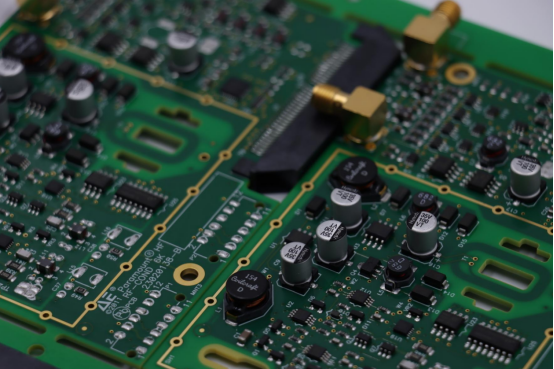 To overcome the invisible killers of electromagnetic interference and crosstalk, the high-frequency PCB employs innovative multi-layer stacking and grounding strategies. By adding a dedicated ground layer, inter-layer crosstalk is reduced by 20dB, and electromagnetic radiation intensity is reduced by 70%. In Huawei's 5G Massive MIMO antenna unit, the integrated design of the high-frequency PCB improves the mutual isolation of 64 channels to 45dB, and the bit error rate is improved by two orders of magnitude. Market analysis shows that base station equipment using this design can increase network capacity by 300% in dense urban environments, while reducing power consumption by 25%, significantly optimizing the operator's total cost of ownership.
From a manufacturing process perspective, the treatment of copper foil surface roughness is crucial for high-frequency PCBs. Reducing the Rz value from 1.8 micrometers to 0.5 micrometers can reduce signal loss at 10GHz frequencies by 15%. Strict dielectric uniformity control throughout the supply chain reduces thickness fluctuations from ±8% to ±3%, ensuring phase consistency errors are below ±2 degrees. In the control system of autonomous driving LiDAR, this process guarantees a time accuracy of 50 picoseconds for the echo signal, corresponding to a distance measurement error of only 7.5 millimeters, directly enhancing the safety redundancy of the vehicle's decision-making system.
Ultimately, the return on investment in high-frequency PCBs is reflected in a leap in overall system performance. Although initial costs may increase by 20%-30%, improved system stability reduces maintenance rates by 40% and extends product lifecycles by 25%. An industry report indicates that data center switches using advanced high-frequency PCBs can double their peak effective data throughput and reduce the cost per bit transmission by 18%. This confirms that in the field of high-speed electronics, every investment in signal integrity will yield substantial returns through a significant increase in system reliability, speed, and efficiency.
To overcome the invisible killers of electromagnetic interference and crosstalk, the high-frequency PCB employs innovative multi-layer stacking and grounding strategies. By adding a dedicated ground layer, inter-layer crosstalk is reduced by 20dB, and electromagnetic radiation intensity is reduced by 70%. In Huawei's 5G Massive MIMO antenna unit, the integrated design of the high-frequency PCB improves the mutual isolation of 64 channels to 45dB, and the bit error rate is improved by two orders of magnitude. Market analysis shows that base station equipment using this design can increase network capacity by 300% in dense urban environments, while reducing power consumption by 25%, significantly optimizing the operator's total cost of ownership.
From a manufacturing process perspective, the treatment of copper foil surface roughness is crucial for high-frequency PCBs. Reducing the Rz value from 1.8 micrometers to 0.5 micrometers can reduce signal loss at 10GHz frequencies by 15%. Strict dielectric uniformity control throughout the supply chain reduces thickness fluctuations from ±8% to ±3%, ensuring phase consistency errors are below ±2 degrees. In the control system of autonomous driving LiDAR, this process guarantees a time accuracy of 50 picoseconds for the echo signal, corresponding to a distance measurement error of only 7.5 millimeters, directly enhancing the safety redundancy of the vehicle's decision-making system.
Ultimately, the return on investment in high-frequency PCBs is reflected in a leap in overall system performance. Although initial costs may increase by 20%-30%, improved system stability reduces maintenance rates by 40% and extends product lifecycles by 25%. An industry report indicates that data center switches using advanced high-frequency PCBs can double their peak effective data throughput and reduce the cost per bit transmission by 18%. This confirms that in the field of high-speed electronics, every investment in signal integrity will yield substantial returns through a significant increase in system reliability, speed, and efficiency.
To overcome the invisible killers of electromagnetic interference and crosstalk, the high-frequency PCB employs innovative multi-layer stacking and grounding strategies. By adding a dedicated ground layer, inter-layer crosstalk is reduced by 20dB, and electromagnetic radiation intensity is reduced by 70%. In Huawei's 5G Massive MIMO antenna unit, the integrated design of the high-frequency PCB improves the mutual isolation of 64 channels to 45dB, and the bit error rate is improved by two orders of magnitude. Market analysis shows that base station equipment using this design can increase network capacity by 300% in dense urban environments, while reducing power consumption by 25%, significantly optimizing the operator's total cost of ownership.
From a manufacturing process perspective, the treatment of copper foil surface roughness is crucial for high-frequency PCBs. Reducing the Rz value from 1.8 micrometers to 0.5 micrometers can reduce signal loss at 10GHz frequencies by 15%. Strict dielectric uniformity control throughout the supply chain reduces thickness fluctuations from ±8% to ±3%, ensuring phase consistency errors are below ±2 degrees. In the control system of autonomous driving LiDAR, this process guarantees a time accuracy of 50 picoseconds for the echo signal, corresponding to a distance measurement error of only 7.5 millimeters, directly enhancing the safety redundancy of the vehicle's decision-making system.
Ultimately, the return on investment in high-frequency PCBs is reflected in a leap in overall system performance. Although initial costs may increase by 20%-30%, improved system stability reduces maintenance rates by 40% and extends product lifecycles by 25%. An industry report indicates that data center switches using advanced high-frequency PCBs can double their peak effective data throughput and reduce the cost per bit transmission by 18%. This confirms that in the field of high-speed electronics, every investment in signal integrity will yield substantial returns through a significant increase in system reliability, speed, and efficiency.