Frameless RTA Cabinets: Space and Access
A framed cabinet puts a 1-1/2-inch face frame in front of the box; a frameless one does not, and that single omission changes what you can get through the opening. On a 30-inch base the difference is roughly 2 inches of clear width, or about 7% more opening, before any drawer or shelf is fitted. Everything else about a frameless box is a normal cabinet: plywood sides, adjustable shelves, soft-close hardware.
Key takeaways
- Without a face frame, the door opening runs the full box width instead of losing 3 inches to the frame.
- Base boxes measure 34-1/2 inches tall and 24 inches deep across 9 to 42-inch widths.
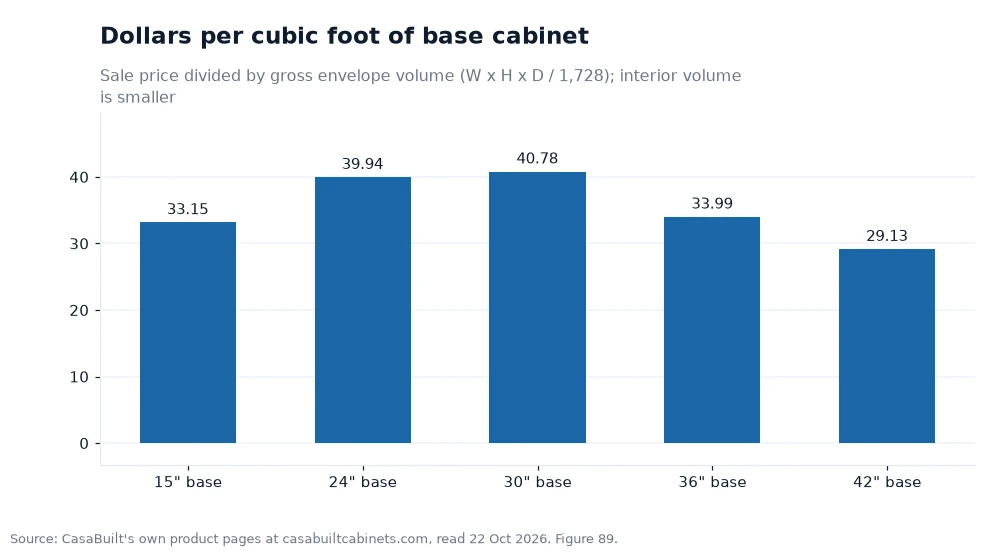
- Dollars per cubic foot peak at the 30-inch base ($40.78) and fall to $29.13 at 42 inches.
- RTA orders ship in 3-10 business days, with Alaska and Hawaii excluded from the standard window.
What frameless removes, and what it does not
A frameless cabinet is a box with doors on the front. There is no face frame around the opening, so the door covers the front edge of the box rather than closing inside a timber surround. The published box is 1/2-inch birch plywood with a natural birch interior, 3/4-inch adjustable plywood shelves, a half-depth shelf in the base cabinets, soft-close concealed hinges and undermount soft-close glides with full extension.
None of those components are unusual. What changes is the geometry in front of them. On a framed cabinet the opening is smaller than the box, because the frame laps over the edge on all four sides. On a frameless cabinet the opening is the box, which gives back the width and height that the frame would have covered.
Usable width, measured rather than assumed
Take a 30-inch base cabinet. In a frameless box, subtract the two side panels at 1/2 inch each, and the clear width between them is about 29 inches. That figure is derived from the published panel gauge, not printed on the page, but it follows from the construction described above.
Now apply the published face frame to the same 30 inches. A 3/4-inch by 1-1/2-inch solid birch frame sits on each side of the opening, so the clear opening is about 30 minus 3, or 27 inches. The box interior may be similar; the hole you reach through is not. The difference is 2 inches, and 2 divided by 27 is 7.4%, so the frameless opening is roughly 7% wider on the same nominal cabinet.
That 7% is what makes the difference visible in daily use. A dinner plate, a sheet pan, a stand mixer and a stack of cereal boxes are all objects with a fixed width, and the opening decides whether they go in flat or at an angle. Over a run of six cabinets, the frameless rta kitchen cabinets give back roughly a foot of opening width compared with the same nominal run.
Price the difference in the other direction. At $586.28 for a 30-inch double-door base, the frameless opening costs $586.28 divided by 29 usable inches, or $20.22 per inch. The same cabinet with a 27-inch framed opening costs $586.28 divided by 27, or $21.71 per inch. Both are derived figures, and both assume the same sale price, which is the point: the geometry is free and the price is not.
The width ladder and the price of volume
Width is the variable that moves both the capacity and the price. The published component list prices a 15-inch single-door base at $238.24, a 24-27 inch double-door base at $459.26 and a 30-42 inch double-door, double-drawer base at $586.28. Three price points cover a 27-inch span of widths, which produces some odd value curves.
| Nominal width | Gross volume | Sale price | Cost per inch |
|---|---|---|---|
| 15" | 7.19 cu ft | $238.24 | $15.88 |
| 24" | 11.50 cu ft | $459.26 | $19.14 |
| 30" | 14.38 cu ft | $586.28 | $19.54 |
| 36" | 17.25 cu ft | $586.28 | $16.29 |
| 42" | 20.13 cu ft | $586.28 | $13.96 |
The 30-inch box carries the highest cost per inch at $19.54, because it is the narrowest cabinet that already carries the wider double-drawer price. The 42-inch box carries the lowest at $13.96, because the same price is spread over 12 more inches. Two 42-inch boxes cover 84 inches of run for $1,172.56; three 30-inch boxes cover 90 inches for $1,758.84, so six extra inches of cabinet costs $586.28 and the wider pair is the cheaper way to fill an 84-inch wall.
Access: drawers, shelves and the corner
Full extension is the specification that turns depth into usable space. An undermount glide with full extension brings the whole drawer box out, so the back of a 24-inch-deep base is reachable without unloading the front. A partial-extension glide leaves the back third inside the box, which is where the items you never use end up.
Shelves are 3/4-inch plywood and adjustable, with a half-depth shelf in the base cabinets. That half-depth shelf is what makes a sink base usable: the plumbing occupies the back, the shelf occupies the front, and nothing has to be notched on site. In a frameless box the shelf can run nearly the full interior width, because there is no frame rebate to clear.
Corners are where frameless geometry earns its keep. The published range includes a corner base at 33-36 inches, a blind base at 33-39 inches and a waste-bin pullout base at 18 inches. A corner unit with a full-width opening is easier to fit with a lazy Susan or a pullout than one whose opening has already been reduced by a frame.
Door alignment is the last piece of access. A frameless run has no frame to hide a door that hangs low, so the six-way adjustable hinges do the work a frame would otherwise mask. Set the gaps after the boxes are level, and before the counter goes on.
Worked example: from a 15-inch box to a 42-inch one
The chart quotes five ratios: $33.15 for the 15-inch base, $39.94 for the 24-inch, $40.78 for the 30-inch, $33.99 for the 36-inch and $29.13 for the 42-inch. Each is a published price divided by gross envelope volume, where volume is the nominal width multiplied by 34.5 inches of height and 24 inches of depth, then divided by 1,728.
Check the smallest. 15 times 34.5 times 24 equals 12,420 cubic inches, and 12,420 divided by 1,728 equals 7.1875 cubic feet. The published price is $238.24, and $238.24 divided by 7.1875 equals $33.15. Now the largest: 42 times 34.5 times 24 equals 34,776 cubic inches, or 20.125 cubic feet, and $586.28 divided by 20.125 equals $29.13.
Compare the ends. $40.78 minus $29.13 is $11.65 per cubic foot, and $11.65 divided by $40.78 is 28.6%, so the 42-inch box is almost 29% cheaper per cubic foot than the 30-inch. In cost per inch of width, $19.54 minus $13.96 is $5.58, and $5.58 divided by $19.54 is 28.6% as well, because both ratios share the same $586.28 numerator. The 30-inch box is the worst value in the ladder on either measure, and the 42-inch box is the best.
Frequently asked questions
Do frameless cabinets lose strength without a face frame?
The published box is 1/2-inch birch plywood with 3/4-inch adjustable shelves and a fixed back, and the doors hang on concealed six-way adjustable hinges. A frame adds stiffness at the front; a frameless box relies on the box panels and the joinery instead, so the panel gauge matters more than the trim.
What widths are available?
Base cabinets run from 9 to 42 inches in the published range, wall cabinets from 9 to 39 inches, and vanities from 12 to 48 inches. Base boxes are 34-1/2 inches high and 24 inches deep; wall cabinets are 12 inches deep in 30, 36 and 42-inch heights.
How long does a flat-pack order take to arrive?
RTA cabinets ship in 3-10 business days, with Alaska and Hawaii excluded from the standard window, and pre-assembled cabinets are quoted at within two weeks. Free shipping applies to orders of $2,500 or more, so a single cabinet usually carries freight.
Measure the opening, not just the wall
Write down the wall length, then the widest object that has to pass through a door opening: a sheet pan, a platter, a mixer. That number, not the cabinet width, decides whether a framed or frameless box works better, and CasaBuilt's measurement guide covers the rest of the room. Then price the ladder by width, because the 30-inch and 42-inch bases share a price and the wider one is the better buy.
Order the layout with the drawers and pullouts where access matters most, and keep the doors adjustable until the counter is on. A frameless kitchen is a geometry decision before it is a style decision, and the geometry is the part that keeps working after the finish has stopped being interesting.
Figures quoted here come from the manufacturer's own website, read 22 Oct 2026[1].